A low rate is meaningless if inclusions differ. Tender comparison should normalise substrate preparation, accessories, transport, testing, warranty, samples, protection and exclusions.
Home › Knowledge Hub › Cost & Budgeting
GLOBALTEK ENGINEERING KNOWLEDGE HUB · ACTIVITY 09
Cost & Budgeting
Cost management converts design information into measured scope, rates, procurement commitments, changes and forecasts. The quality of the budget depends more on scope definition and quantity traceability than on the apparent precision of a unit rate.

GUIDE MAP
Read the discipline visually, then go into the engineering detail.
Every image below is activity-specific. No repeated generic placeholder sheets are used in this guide.
01
System Overview
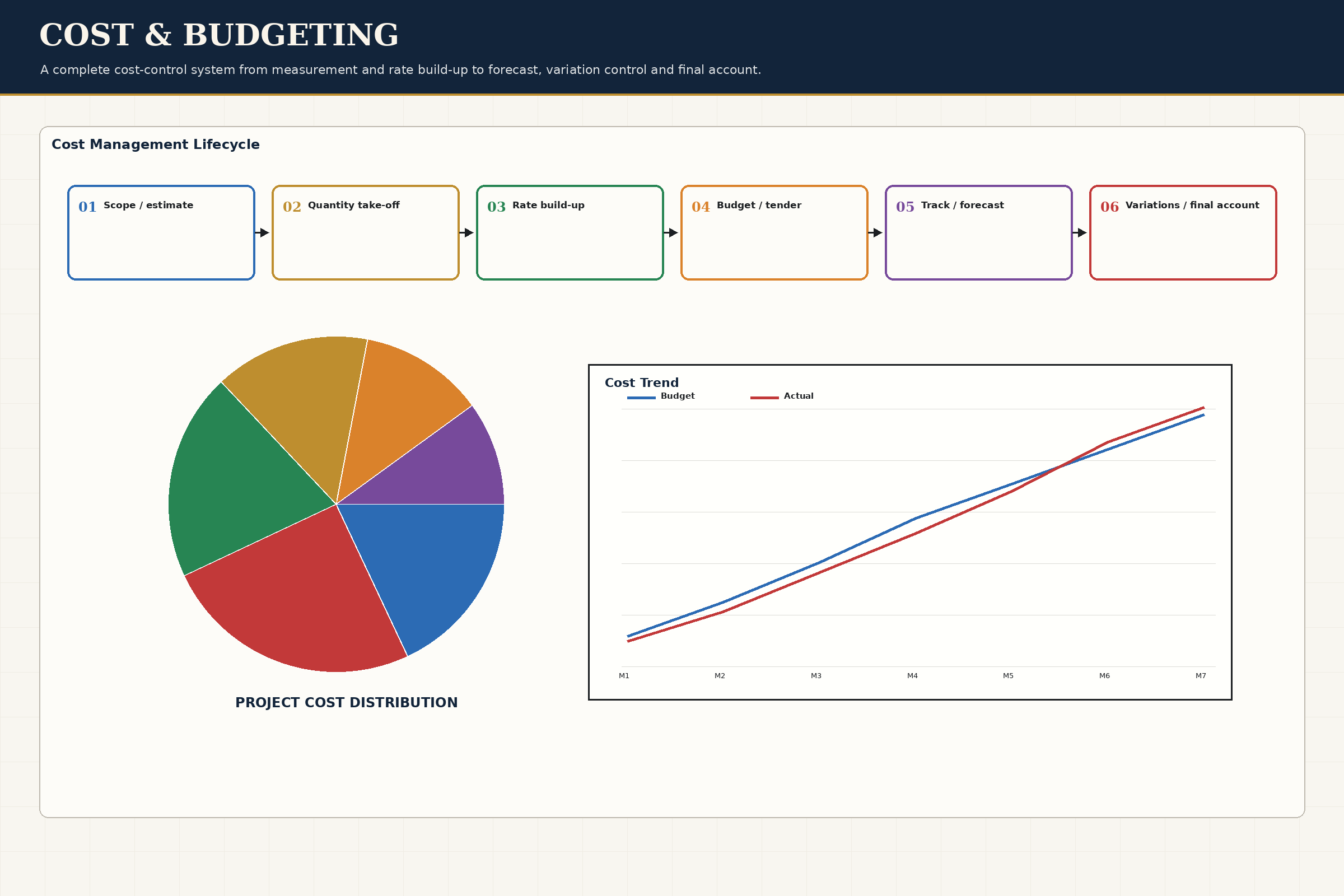
Cost management covers estimating, quantity take-off, tendering, value engineering, contract pricing, variations, interim valuations, cost-to-complete and final account. Its purpose is to help decisions happen before money is irreversibly committed.
Open section →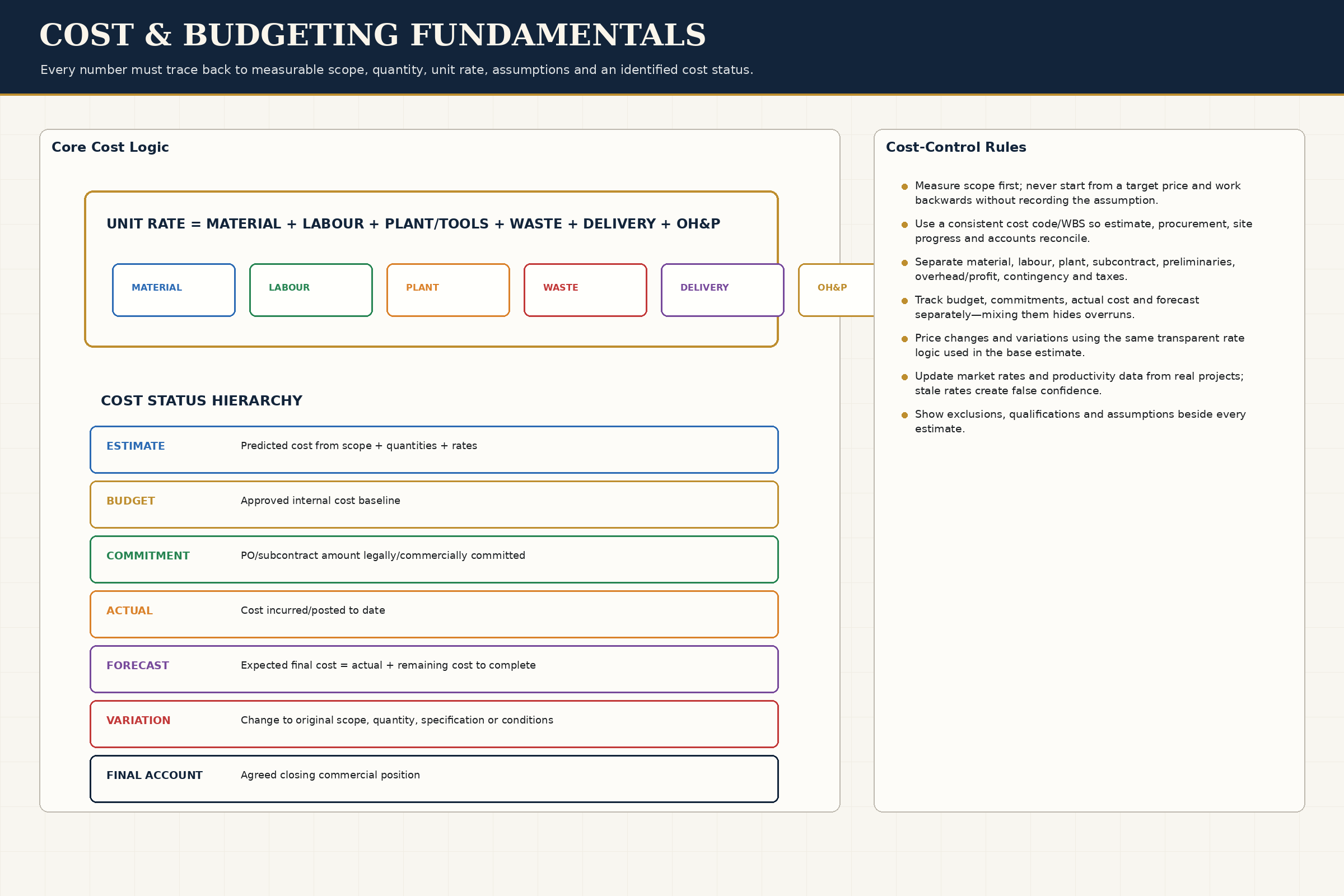
02
Engineering Fundamentals
Use a measurable WBS aligned with drawings/specification
Open section →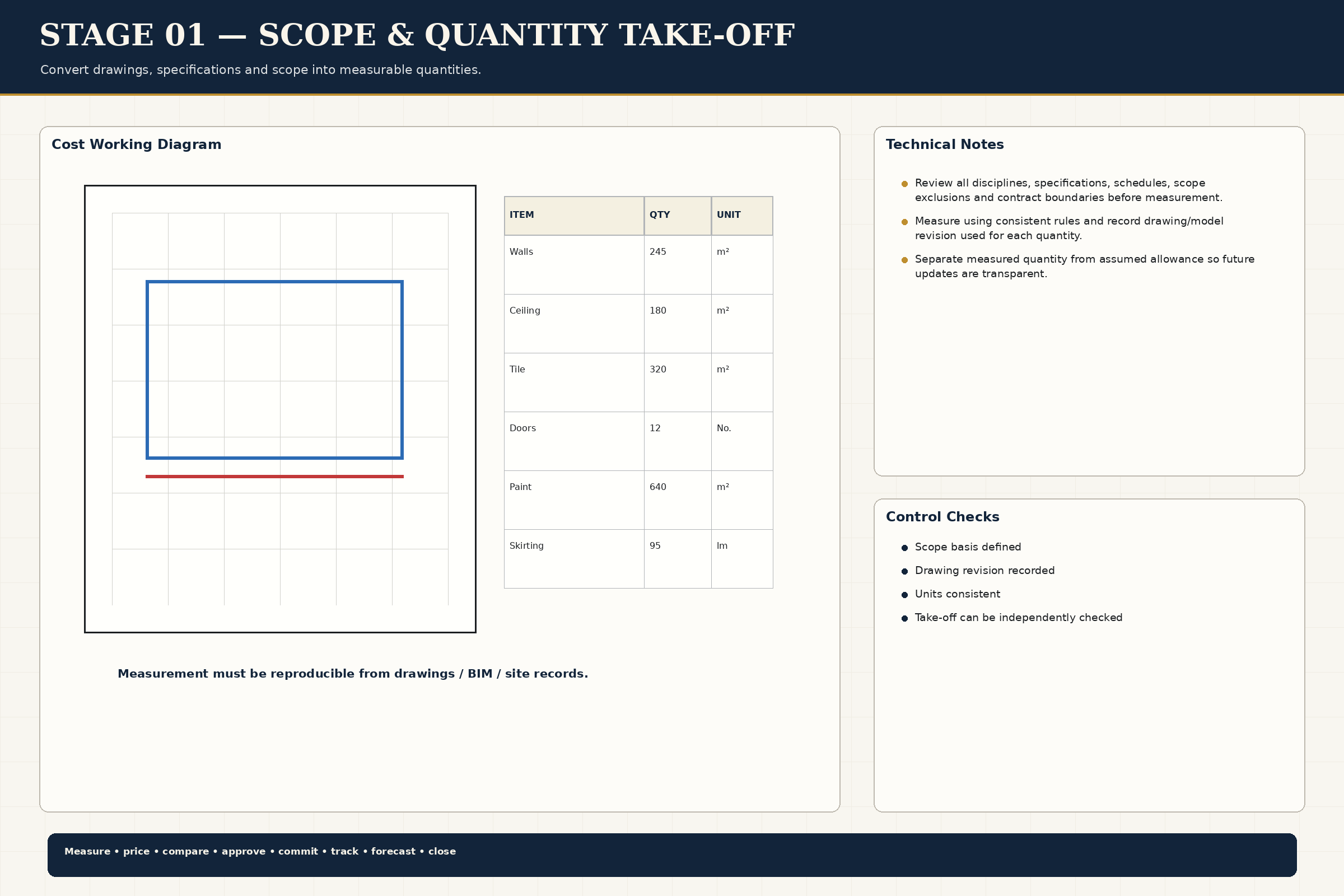
03
Execution Workflow
Define inclusions, exclusions, quantities available and uncertainty level
Open section →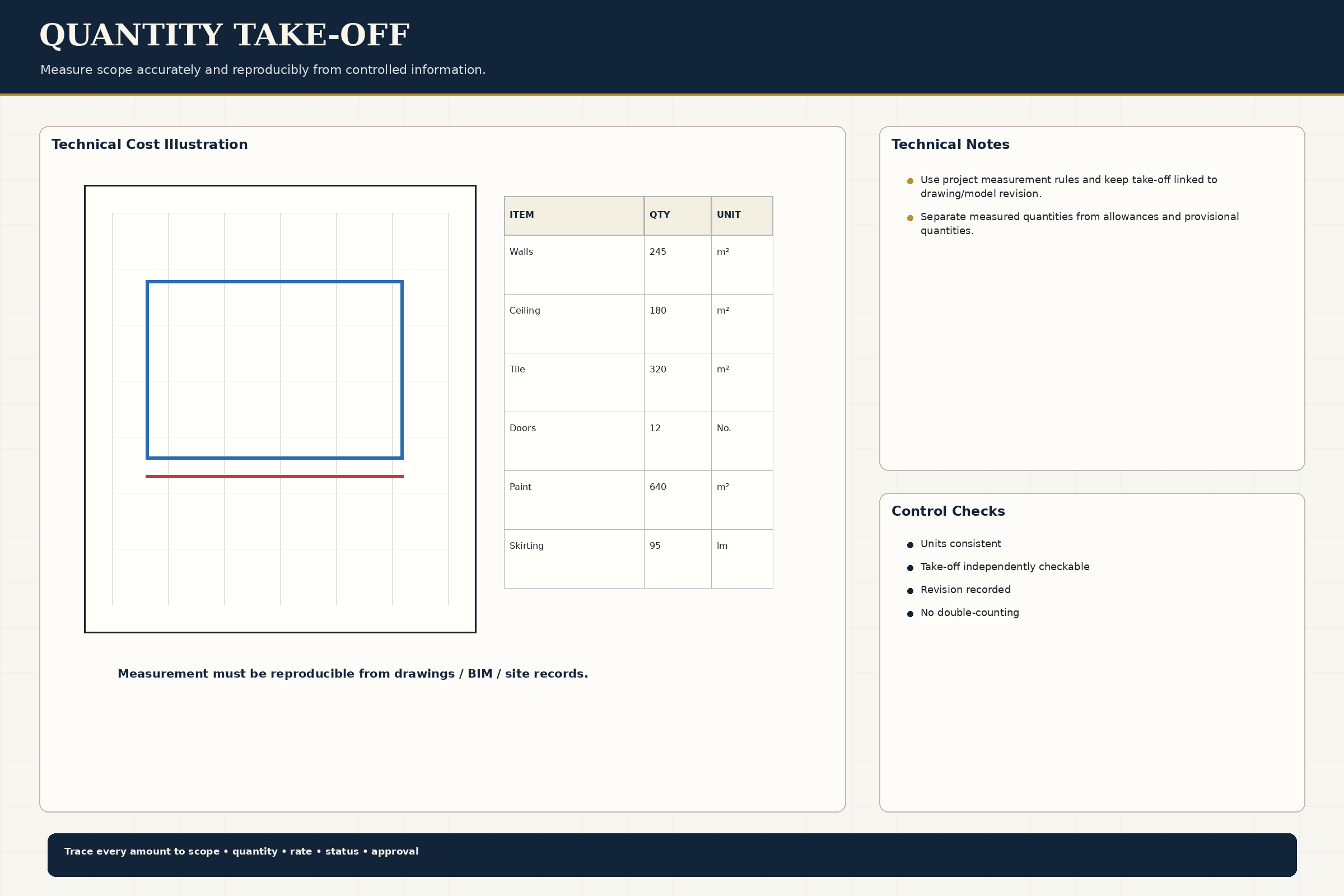
04
Technical Chapters
21 individual sub-activity drawings with discipline-specific notes and inspection controls.
Open section →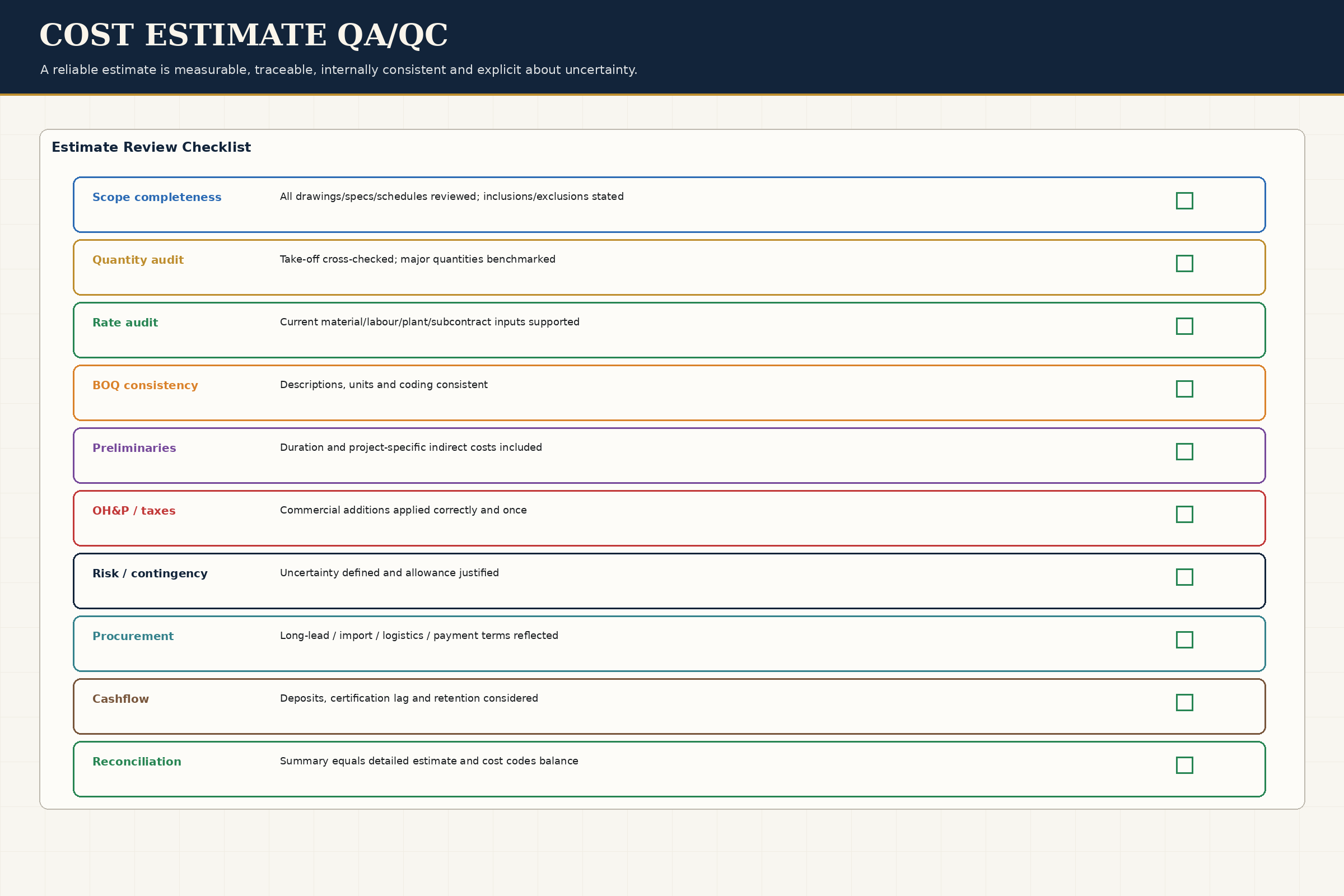
05
QA/QC
Budget references the correct design revision
Open section →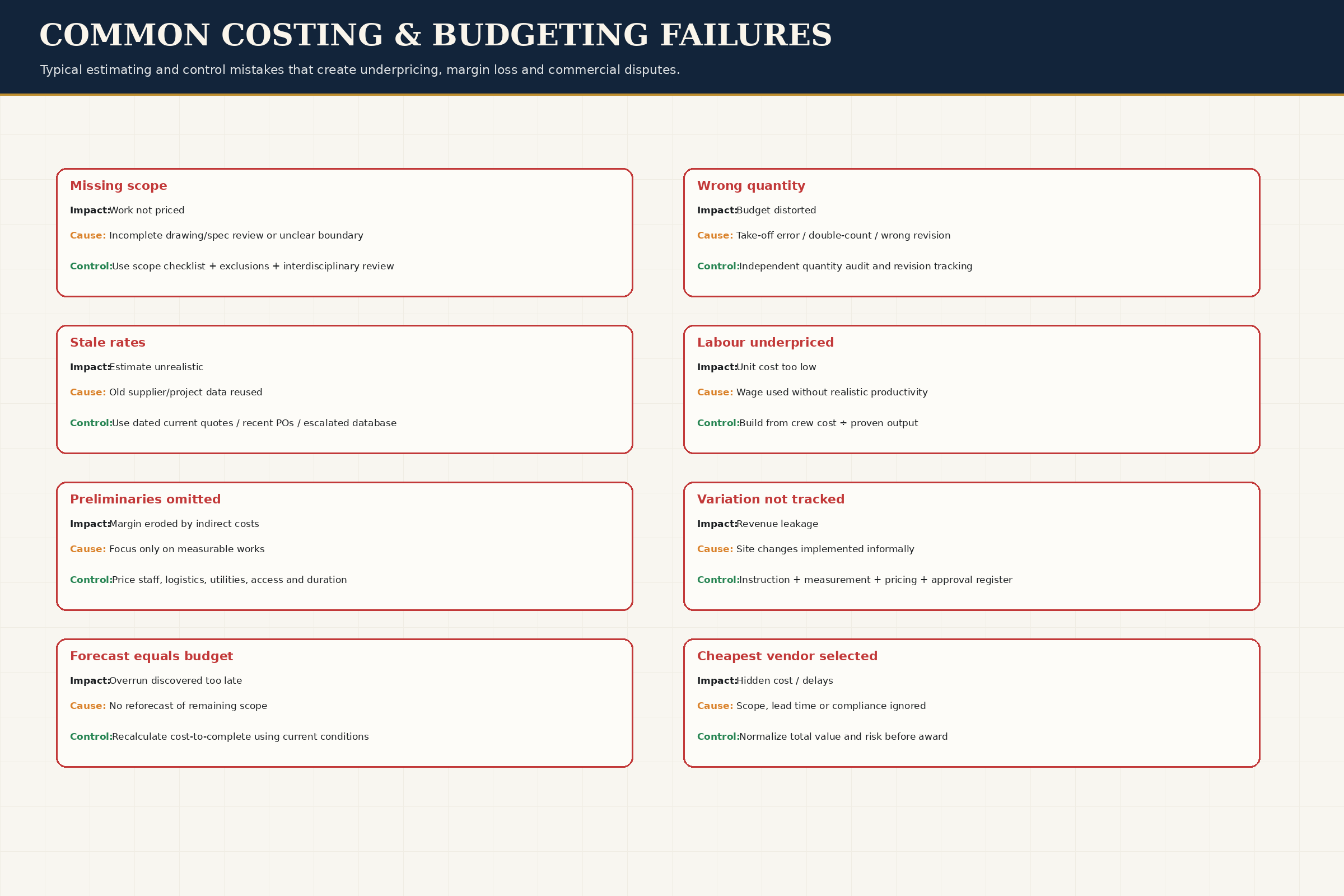
06
Failure Analysis
Using early allowance as if it were a fixed price
Open section →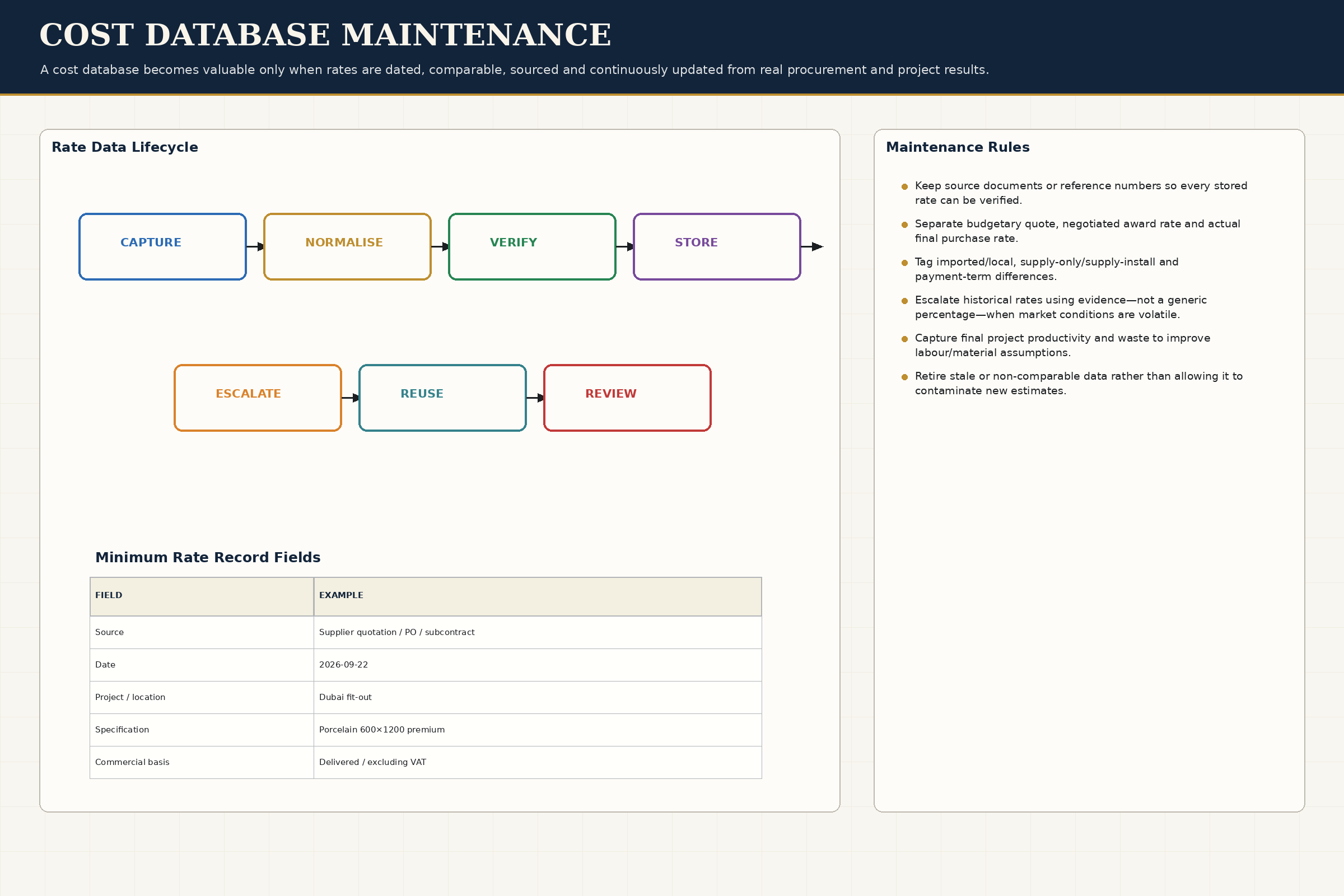
07
Maintenance
Maintain lifecycle cost records for major replaceable assets
Open section →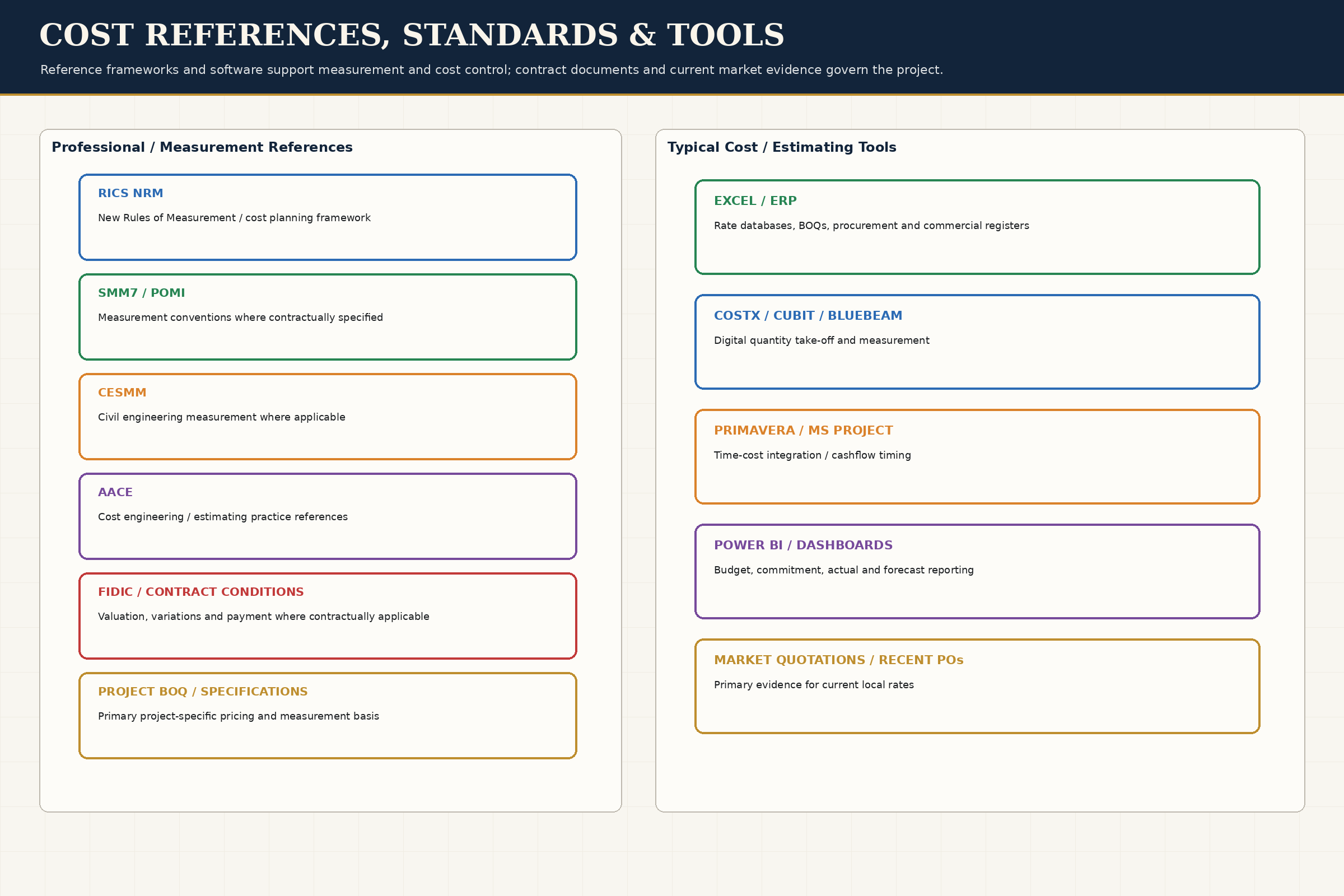
08
Standards & Brands
Contract measurement rules / bill preambles where applicable
Open section →01 · SYSTEM OVERVIEW
What this activity is
What this activity is
Cost management covers estimating, quantity take-off, tendering, value engineering, contract pricing, variations, interim valuations, cost-to-complete and final account. Its purpose is to help decisions happen before money is irreversibly committed.
What to expect
Expect the budget to evolve as design information improves. Early estimates use allowances and benchmarks; later estimates should be based on measurable drawings, specifications, approved materials and supplier / subcontractor quotations. A useful cost report shows what is committed, forecast, varied and still uncertain—not only what has been paid.
01Use a measurable WBS aligned with drawings/specification
02Separate base scope, allowances, provisional items and exclusions
03Track quantities to drawing revisions
04Normalise tender comparisons before selecting a supplier
05Record approved/forecast variations separately
06Forecast final cost using commitments and remaining work, not invoices alone
02 · ENGINEERING FUNDAMENTALS
Understand why the system behaves the way it does.
01
Amount = measured quantity × analysed unit rate
02
Forecast final cost = actual paid + committed unpaid + forecast remaining + approved/likely change allowance
03
Rate build-up = material + labour + plant + wastage + logistics + supervision/overhead + risk/profit as applicable
Quantity take-off should be revision controlled. When drawings change, quantities must be delta-checked so omissions and double counting do not enter the forecast.
Value engineering is not simple cost cutting; it tests function, performance, lead time, maintenance and whole-life risk against alternative systems.
03 · EXECUTION WORKFLOW
Six progressive stages from preparation to verified handover.
Open any plate to read the full-resolution technical notes.
01Scope Takeoff 02BOQ Preparation
 03Rate Build Up
 04Quotation Comparison
 05Cost Tracking Forecast
 06Final Account Closeout
STAGE 01
Scope Takeoff
Define inclusions, exclusions, quantities available and uncertainty level
Engineering intent
Higher at concept stage; reduce as information is frozen
Inspection / hold point
Budget references the correct design revision
Best practice
Always issue a basis-of-estimate page with revision, assumptions and exclusions
Failure to avoid
Using early allowance as if it were a fixed price
Handover / maintenance
Maintain lifecycle cost records for major replaceable assets
STAGE 02
BOQ Preparation
Measure by trade and build rates from current market / project data
Engineering intent
State drawing revision and measurement rules for every major take-off
Inspection / hold point
Quantity take-off is auditable and traceable
Best practice
Compare offers on normalised scope, not headline total only
Failure to avoid
Comparing bids that contain different exclusions
Handover / maintenance
Record final supplier, model, rate and quantity data for future refurbishment budgets
STAGE 03
Rate Build Up
Issue comparable scopes and reconcile commercial / technical clarifications
Engineering intent
Material + labour + plant + waste + logistics + preliminaries + overhead / margin as relevant
Inspection / hold point
Tender comparisons reconcile exclusions and alternates
Best practice
Track owner changes separately from contractor errors / rework
Failure to avoid
Ignoring waste, logistics, access and protection costs
Handover / maintenance
Review recurring maintenance cost when selecting replacement materials
STAGE 04
Quotation Comparison
Track commitments, changes, savings, risk allowances and cost-to-complete
Engineering intent
Separate price validity, currency / shipping exposure and lead-time impact
Inspection / hold point
Variation log agrees with instruction / approval status
Best practice
Update forecast after every significant procurement decision
Failure to avoid
Pricing variations long after work is completed with poor records
Handover / maintenance
Update replacement reserve / capital plan for high-cost assets
STAGE 05
Cost Tracking Forecast
Measure progress and document instructions contemporaneously
Engineering intent
Define what is included and how later adjustment will be valued
Inspection / hold point
Forecast includes committed and remaining cost without double-counting
Best practice
Value engineer performance and lifecycle together with capital cost
Failure to avoid
Double-counting committed costs in forecast
Handover / maintenance
Keep warranties and spare-parts pricing with cost records where practical
STAGE 06
Final Account Closeout
Close outstanding measurements, variations, credits and contract adjustments
Engineering intent
Record instruction date, status, quoted amount, approved amount and programme effect
Inspection / hold point
Final account records are complete and supported
Best practice
Keep quotation validity and lead time visible in procurement decisions
Failure to avoid
Reducing quality / performance without documenting the technical consequence
Handover / maintenance
Maintain lifecycle cost records for major replaceable assets
04 · TECHNICAL CHAPTERS
21 detailed sub-activities for Cost & Budgeting.
The file naming and page mapping are one-to-one: each technical subject has its own individual high-resolution image.
01Quantity Takeoff02BOQ Structure03Material Costing04Labour Costing05Plant Tools Equipment06Unit Rate Build Up07Vendor Subcontract Comparison08Preliminaries Overheads Profit09Contingency Risk Allowance10Cashflow Funding11Earned Value12Budget Vs Actual13Variation Pricing14Value Engineering15Procurement Cost Comparison16Forecast At Completion17Progress Valuation Certification18Final Account19Life Cycle Costing20Cost Benchmarking21Market Rate Database
TECHNICAL CHAPTER 01
Quantity Takeoff
Quantity Takeoff: Coordinate quantities, rate build-ups, labour/productivity, procurement allowances, preliminaries, waste, variations, cash flow, contingencies and cost reporting against an approved baseline.
Design intent
Define the performance and construction intent for quantity takeoff before fabrication or installation. Read the drawing together with the approved project specification, manufacturer data and adjoining details.
Coordination
Coordinate quantities, rate build-ups, labour/productivity, procurement allowances, preliminaries, waste, variations, cash flow, contingencies and cost reporting against an approved baseline.
Inspection / QA
Budget references the correct design revision
Failure to avoid
Using early allowance as if it were a fixed price
Maintenance / long-term performance
Maintain lifecycle cost records for major replaceable assets

TECHNICAL CHAPTER 02
BOQ Structure
BOQ Structure: Coordinate quantities, rate build-ups, labour/productivity, procurement allowances, preliminaries, waste, variations, cash flow, contingencies and cost reporting against an approved baseline.
Design intent
Define the performance and construction intent for boq structure before fabrication or installation. Read the drawing together with the approved project specification, manufacturer data and adjoining details.
Coordination
Coordinate quantities, rate build-ups, labour/productivity, procurement allowances, preliminaries, waste, variations, cash flow, contingencies and cost reporting against an approved baseline.
Inspection / QA
Quantity take-off is auditable and traceable
Failure to avoid
Comparing bids that contain different exclusions
Maintenance / long-term performance
Record final supplier, model, rate and quantity data for future refurbishment budgets

TECHNICAL CHAPTER 03
Material Costing
Material Costing: Coordinate quantities, rate build-ups, labour/productivity, procurement allowances, preliminaries, waste, variations, cash flow, contingencies and cost reporting against an approved baseline.
Design intent
Define the performance and construction intent for material costing before fabrication or installation. Read the drawing together with the approved project specification, manufacturer data and adjoining details.
Coordination
Coordinate quantities, rate build-ups, labour/productivity, procurement allowances, preliminaries, waste, variations, cash flow, contingencies and cost reporting against an approved baseline.
Inspection / QA
Tender comparisons reconcile exclusions and alternates
Failure to avoid
Ignoring waste, logistics, access and protection costs
Maintenance / long-term performance
Review recurring maintenance cost when selecting replacement materials

TECHNICAL CHAPTER 04
Labour Costing
Labour Costing: Coordinate quantities, rate build-ups, labour/productivity, procurement allowances, preliminaries, waste, variations, cash flow, contingencies and cost reporting against an approved baseline.
Design intent
Define the performance and construction intent for labour costing before fabrication or installation. Read the drawing together with the approved project specification, manufacturer data and adjoining details.
Coordination
Coordinate quantities, rate build-ups, labour/productivity, procurement allowances, preliminaries, waste, variations, cash flow, contingencies and cost reporting against an approved baseline.
Inspection / QA
Variation log agrees with instruction / approval status
Failure to avoid
Pricing variations long after work is completed with poor records
Maintenance / long-term performance
Update replacement reserve / capital plan for high-cost assets

TECHNICAL CHAPTER 05
Plant Tools Equipment
Plant Tools Equipment: Coordinate quantities, rate build-ups, labour/productivity, procurement allowances, preliminaries, waste, variations, cash flow, contingencies and cost reporting against an approved baseline.
Design intent
Define the performance and construction intent for plant tools equipment before fabrication or installation. Read the drawing together with the approved project specification, manufacturer data and adjoining details.
Coordination
Coordinate quantities, rate build-ups, labour/productivity, procurement allowances, preliminaries, waste, variations, cash flow, contingencies and cost reporting against an approved baseline.
Inspection / QA
Forecast includes committed and remaining cost without double-counting
Failure to avoid
Double-counting committed costs in forecast
Maintenance / long-term performance
Keep warranties and spare-parts pricing with cost records where practical

TECHNICAL CHAPTER 06
Unit Rate Build Up
Unit Rate Build Up: Coordinate quantities, rate build-ups, labour/productivity, procurement allowances, preliminaries, waste, variations, cash flow, contingencies and cost reporting against an approved baseline.
Design intent
Define the performance and construction intent for unit rate build up before fabrication or installation. Read the drawing together with the approved project specification, manufacturer data and adjoining details.
Coordination
Coordinate quantities, rate build-ups, labour/productivity, procurement allowances, preliminaries, waste, variations, cash flow, contingencies and cost reporting against an approved baseline.
Inspection / QA
Final account records are complete and supported
Failure to avoid
Reducing quality / performance without documenting the technical consequence
Maintenance / long-term performance
Maintain lifecycle cost records for major replaceable assets

TECHNICAL CHAPTER 07
Vendor Subcontract Comparison
Vendor Subcontract Comparison: Coordinate quantities, rate build-ups, labour/productivity, procurement allowances, preliminaries, waste, variations, cash flow, contingencies and cost reporting against an approved baseline.
Design intent
Define the performance and construction intent for vendor subcontract comparison before fabrication or installation. Read the drawing together with the approved project specification, manufacturer data and adjoining details.
Coordination
Coordinate quantities, rate build-ups, labour/productivity, procurement allowances, preliminaries, waste, variations, cash flow, contingencies and cost reporting against an approved baseline.
Inspection / QA
Budget references the correct design revision
Failure to avoid
Using early allowance as if it were a fixed price
Maintenance / long-term performance
Record final supplier, model, rate and quantity data for future refurbishment budgets

TECHNICAL CHAPTER 08
Preliminaries Overheads Profit
Preliminaries Overheads Profit: Coordinate quantities, rate build-ups, labour/productivity, procurement allowances, preliminaries, waste, variations, cash flow, contingencies and cost reporting against an approved baseline.
Design intent
Define the performance and construction intent for preliminaries overheads profit before fabrication or installation. Read the drawing together with the approved project specification, manufacturer data and adjoining details.
Coordination
Coordinate quantities, rate build-ups, labour/productivity, procurement allowances, preliminaries, waste, variations, cash flow, contingencies and cost reporting against an approved baseline.
Inspection / QA
Quantity take-off is auditable and traceable
Failure to avoid
Comparing bids that contain different exclusions
Maintenance / long-term performance
Review recurring maintenance cost when selecting replacement materials

TECHNICAL CHAPTER 09
Contingency Risk Allowance
Contingency Risk Allowance: Coordinate quantities, rate build-ups, labour/productivity, procurement allowances, preliminaries, waste, variations, cash flow, contingencies and cost reporting against an approved baseline.
Design intent
Define the performance and construction intent for contingency risk allowance before fabrication or installation. Read the drawing together with the approved project specification, manufacturer data and adjoining details.
Coordination
Coordinate quantities, rate build-ups, labour/productivity, procurement allowances, preliminaries, waste, variations, cash flow, contingencies and cost reporting against an approved baseline.
Inspection / QA
Tender comparisons reconcile exclusions and alternates
Failure to avoid
Ignoring waste, logistics, access and protection costs
Maintenance / long-term performance
Update replacement reserve / capital plan for high-cost assets

TECHNICAL CHAPTER 10
Cashflow Funding
Cashflow Funding: Coordinate quantities, rate build-ups, labour/productivity, procurement allowances, preliminaries, waste, variations, cash flow, contingencies and cost reporting against an approved baseline.
Design intent
Define the performance and construction intent for cashflow funding before fabrication or installation. Read the drawing together with the approved project specification, manufacturer data and adjoining details.
Coordination
Coordinate quantities, rate build-ups, labour/productivity, procurement allowances, preliminaries, waste, variations, cash flow, contingencies and cost reporting against an approved baseline.
Inspection / QA
Variation log agrees with instruction / approval status
Failure to avoid
Pricing variations long after work is completed with poor records
Maintenance / long-term performance
Keep warranties and spare-parts pricing with cost records where practical

TECHNICAL CHAPTER 11
Earned Value
Earned Value: Coordinate quantities, rate build-ups, labour/productivity, procurement allowances, preliminaries, waste, variations, cash flow, contingencies and cost reporting against an approved baseline.
Design intent
Define the performance and construction intent for earned value before fabrication or installation. Read the drawing together with the approved project specification, manufacturer data and adjoining details.
Coordination
Coordinate quantities, rate build-ups, labour/productivity, procurement allowances, preliminaries, waste, variations, cash flow, contingencies and cost reporting against an approved baseline.
Inspection / QA
Forecast includes committed and remaining cost without double-counting
Failure to avoid
Double-counting committed costs in forecast
Maintenance / long-term performance
Maintain lifecycle cost records for major replaceable assets

TECHNICAL CHAPTER 12
Budget Vs Actual
Budget Vs Actual: Coordinate quantities, rate build-ups, labour/productivity, procurement allowances, preliminaries, waste, variations, cash flow, contingencies and cost reporting against an approved baseline.
Design intent
Define the performance and construction intent for budget vs actual before fabrication or installation. Read the drawing together with the approved project specification, manufacturer data and adjoining details.
Coordination
Coordinate quantities, rate build-ups, labour/productivity, procurement allowances, preliminaries, waste, variations, cash flow, contingencies and cost reporting against an approved baseline.
Inspection / QA
Final account records are complete and supported
Failure to avoid
Reducing quality / performance without documenting the technical consequence
Maintenance / long-term performance
Record final supplier, model, rate and quantity data for future refurbishment budgets

TECHNICAL CHAPTER 13
Variation Pricing
Variation Pricing: Coordinate quantities, rate build-ups, labour/productivity, procurement allowances, preliminaries, waste, variations, cash flow, contingencies and cost reporting against an approved baseline.
Design intent
Define the performance and construction intent for variation pricing before fabrication or installation. Read the drawing together with the approved project specification, manufacturer data and adjoining details.
Coordination
Coordinate quantities, rate build-ups, labour/productivity, procurement allowances, preliminaries, waste, variations, cash flow, contingencies and cost reporting against an approved baseline.
Inspection / QA
Budget references the correct design revision
Failure to avoid
Using early allowance as if it were a fixed price
Maintenance / long-term performance
Review recurring maintenance cost when selecting replacement materials

TECHNICAL CHAPTER 14
Value Engineering
Value Engineering: Coordinate quantities, rate build-ups, labour/productivity, procurement allowances, preliminaries, waste, variations, cash flow, contingencies and cost reporting against an approved baseline.
Design intent
Define the performance and construction intent for value engineering before fabrication or installation. Read the drawing together with the approved project specification, manufacturer data and adjoining details.
Coordination
Coordinate quantities, rate build-ups, labour/productivity, procurement allowances, preliminaries, waste, variations, cash flow, contingencies and cost reporting against an approved baseline.
Inspection / QA
Quantity take-off is auditable and traceable
Failure to avoid
Comparing bids that contain different exclusions
Maintenance / long-term performance
Update replacement reserve / capital plan for high-cost assets

TECHNICAL CHAPTER 15
Procurement Cost Comparison
Procurement Cost Comparison: Coordinate quantities, rate build-ups, labour/productivity, procurement allowances, preliminaries, waste, variations, cash flow, contingencies and cost reporting against an approved baseline.
Design intent
Define the performance and construction intent for procurement cost comparison before fabrication or installation. Read the drawing together with the approved project specification, manufacturer data and adjoining details.
Coordination
Coordinate quantities, rate build-ups, labour/productivity, procurement allowances, preliminaries, waste, variations, cash flow, contingencies and cost reporting against an approved baseline.
Inspection / QA
Tender comparisons reconcile exclusions and alternates
Failure to avoid
Ignoring waste, logistics, access and protection costs
Maintenance / long-term performance
Keep warranties and spare-parts pricing with cost records where practical

TECHNICAL CHAPTER 16
Forecast At Completion
Forecast At Completion: Coordinate quantities, rate build-ups, labour/productivity, procurement allowances, preliminaries, waste, variations, cash flow, contingencies and cost reporting against an approved baseline.
Design intent
Define the performance and construction intent for forecast at completion before fabrication or installation. Read the drawing together with the approved project specification, manufacturer data and adjoining details.
Coordination
Coordinate quantities, rate build-ups, labour/productivity, procurement allowances, preliminaries, waste, variations, cash flow, contingencies and cost reporting against an approved baseline.
Inspection / QA
Variation log agrees with instruction / approval status
Failure to avoid
Pricing variations long after work is completed with poor records
Maintenance / long-term performance
Maintain lifecycle cost records for major replaceable assets

TECHNICAL CHAPTER 17
Progress Valuation Certification
Progress Valuation Certification: Coordinate quantities, rate build-ups, labour/productivity, procurement allowances, preliminaries, waste, variations, cash flow, contingencies and cost reporting against an approved baseline.
Design intent
Define the performance and construction intent for progress valuation certification before fabrication or installation. Read the drawing together with the approved project specification, manufacturer data and adjoining details.
Coordination
Coordinate quantities, rate build-ups, labour/productivity, procurement allowances, preliminaries, waste, variations, cash flow, contingencies and cost reporting against an approved baseline.
Inspection / QA
Forecast includes committed and remaining cost without double-counting
Failure to avoid
Double-counting committed costs in forecast
Maintenance / long-term performance
Record final supplier, model, rate and quantity data for future refurbishment budgets

TECHNICAL CHAPTER 18
Final Account
Final Account: Coordinate quantities, rate build-ups, labour/productivity, procurement allowances, preliminaries, waste, variations, cash flow, contingencies and cost reporting against an approved baseline.
Design intent
Define the performance and construction intent for final account before fabrication or installation. Read the drawing together with the approved project specification, manufacturer data and adjoining details.
Coordination
Coordinate quantities, rate build-ups, labour/productivity, procurement allowances, preliminaries, waste, variations, cash flow, contingencies and cost reporting against an approved baseline.
Inspection / QA
Final account records are complete and supported
Failure to avoid
Reducing quality / performance without documenting the technical consequence
Maintenance / long-term performance
Review recurring maintenance cost when selecting replacement materials

TECHNICAL CHAPTER 19
Life Cycle Costing
Life Cycle Costing: Coordinate quantities, rate build-ups, labour/productivity, procurement allowances, preliminaries, waste, variations, cash flow, contingencies and cost reporting against an approved baseline.
Design intent
Define the performance and construction intent for life cycle costing before fabrication or installation. Read the drawing together with the approved project specification, manufacturer data and adjoining details.
Coordination
Coordinate quantities, rate build-ups, labour/productivity, procurement allowances, preliminaries, waste, variations, cash flow, contingencies and cost reporting against an approved baseline.
Inspection / QA
Budget references the correct design revision
Failure to avoid
Using early allowance as if it were a fixed price
Maintenance / long-term performance
Update replacement reserve / capital plan for high-cost assets

TECHNICAL CHAPTER 20
Cost Benchmarking
Cost Benchmarking: Coordinate quantities, rate build-ups, labour/productivity, procurement allowances, preliminaries, waste, variations, cash flow, contingencies and cost reporting against an approved baseline.
Design intent
Define the performance and construction intent for cost benchmarking before fabrication or installation. Read the drawing together with the approved project specification, manufacturer data and adjoining details.
Coordination
Coordinate quantities, rate build-ups, labour/productivity, procurement allowances, preliminaries, waste, variations, cash flow, contingencies and cost reporting against an approved baseline.
Inspection / QA
Quantity take-off is auditable and traceable
Failure to avoid
Comparing bids that contain different exclusions
Maintenance / long-term performance
Keep warranties and spare-parts pricing with cost records where practical

TECHNICAL CHAPTER 21
Market Rate Database
Market Rate Database: Coordinate quantities, rate build-ups, labour/productivity, procurement allowances, preliminaries, waste, variations, cash flow, contingencies and cost reporting against an approved baseline.
Design intent
Define the performance and construction intent for market rate database before fabrication or installation. Read the drawing together with the approved project specification, manufacturer data and adjoining details.
Coordination
Coordinate quantities, rate build-ups, labour/productivity, procurement allowances, preliminaries, waste, variations, cash flow, contingencies and cost reporting against an approved baseline.
Inspection / QA
Tender comparisons reconcile exclusions and alternates
Failure to avoid
Ignoring waste, logistics, access and protection costs
Maintenance / long-term performance
Maintain lifecycle cost records for major replaceable assets
05 · QA/QC
Inspect before concealment and before handover.
01Budget references the correct design revision
02Quantity take-off is auditable and traceable
03Tender comparisons reconcile exclusions and alternates
04Variation log agrees with instruction / approval status
05Forecast includes committed and remaining cost without double-counting
06Final account records are complete and supported
06 · COMMON FAILURES
Recognise the failure mechanism—not only the visible defect.
Failures to avoid
×Using early allowance as if it were a fixed price
×Comparing bids that contain different exclusions
×Ignoring waste, logistics, access and protection costs
×Pricing variations long after work is completed with poor records
×Double-counting committed costs in forecast
×Reducing quality / performance without documenting the technical consequence
07 · MAINTENANCE & AFTERCARE
Design for access, repair and long-term performance.
Maintenance controls
✓Maintain lifecycle cost records for major replaceable assets
✓Record final supplier, model, rate and quantity data for future refurbishment budgets
✓Review recurring maintenance cost when selecting replacement materials
✓Update replacement reserve / capital plan for high-cost assets
✓Keep warranties and spare-parts pricing with cost records where practical
08 · STANDARDS & MANUFACTURER REFERENCES
Use the latest approved project documents and tested systems.
• Contract measurement rules / bill preambles where applicable
• POMI / NRM / CESMM principles only where the contract adopts or references them
• Approved drawings, specifications, schedules and scope matrix
• Current quotations and written supplier / subcontractor clarifications
• Contract change / notice / valuation procedures
• Documented assumptions, exclusions, provisional sums and contingencies
Technical guidance is educational and indicative. Final design, dimensions, materials, installation details and acceptance criteria must follow the approved project documents, manufacturer instructions and the latest requirements of the relevant UAE authority, landlord, consultant and specialist engineer.
09 · COMPLETE IMAGE LIBRARY
34 high-resolution visuals assigned to this activity.
Each file remains separate and is mapped directly to its relevant section. Click any image to inspect it at full resolution.
HeroOverviewFundamentalsQA/QCFailuresMaintenanceStandards & Brands Stage 01 · Scope TakeoffStage 02 · BOQ PreparationStage 03 · Rate Build UpStage 04 · Quotation ComparisonStage 05 · Cost Tracking ForecastStage 06 · Final Account Closeout 01 · Quantity Takeoff02 · BOQ Structure03 · Material Costing04 · Labour Costing05 · Plant Tools Equipment06 · Unit Rate Build Up07 · Vendor Subcontract Comparison08 · Preliminaries Overheads Profit09 · Contingency Risk Allowance10 · Cashflow Funding11 · Earned Value12 · Budget Vs Actual13 · Variation Pricing14 · Value Engineering15 · Procurement Cost Comparison16 · Forecast At Completion17 · Progress Valuation Certification18 · Final Account19 · Life Cycle Costing20 · Cost Benchmarking21 · Market Rate Database